SACRAMENTO — A federal judge on Friday barred California from reducing payments for certain Medicaid services for developmentally disabled Californians.
Medicaid providers will not have to comply with a policy forcing them to bill for only half a day when they work for less than 65 percent of the workday.
Showing posts with label cuts to Medicaid. Show all posts
Showing posts with label cuts to Medicaid. Show all posts
Wednesday, February 18, 2015

Sunday, February 12, 2012
Young Adults Fear Medicaid Overaul
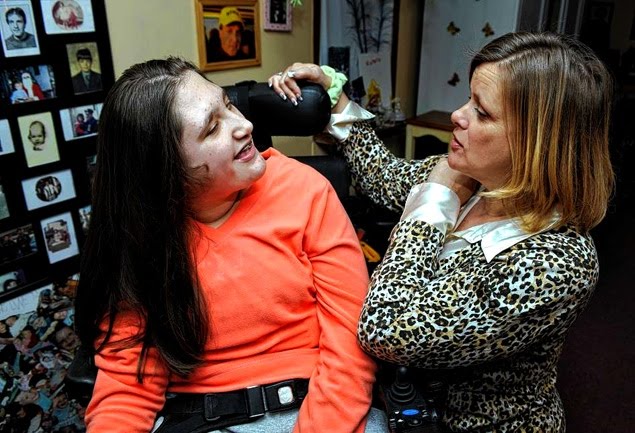 NEW YORK, N.Y. -- Thousands of young New Yorkers struggling with chronic illnesses are facing a new battle — they fear an overhaul of Medicaid will jeopardize their health care services when they turn 21.
These patients, some of whom were not expected to survive into adulthood, are living longer because of medical advancements.
But that means they will be affected by a new Medicaid cost-cutting plan to transfer physically impaired adults into managed long-term care programs.
Tuesday, January 3, 2012
Opinion: Kansas Shouldn't Shift Medicaid Program to Managed Care Too Quickly
TOPEKA, Kans. -- Health care providers and advocates — as well as state legislators — have ample reason to be nervous and cautious about major changes in the state’s Medicaid program.
The rising costs of the program make it a natural target for Kansas officials trying to trim the state budget or divert funds to other uses. Kansas isn’t the only state that is pursuing ways to cut its Medicaid costs — sometimes with mixed success.
Kansas already uses a private managed care provider for its HealthWave program, which serves children in low-income families. Gov. Sam Brownback now is proposing a plan that would include the elderly, disabled and mentally ill in managed care plans and to make the entire transition in one year’s time, by Jan. 1, 2013. Although other states are moving toward managed care plans administered by private insurance companies, making such a fast and complete shift is unusual. What works for children in low-income families may not work as well for elderly nursing home residents or people who need long-term assistance because of developmental disabilities.
Thursday, November 10, 2011
Autism Hits Home Amid Funding Cuts
 STATEN ISLAND, N.Y. -- Barbara and Billy D’Amora have three children, but their oldest son, Nicholas, 13, takes up a lot of their attention. Nick has autism.
“Everyone needs a piece of me,” Mrs. D’Amora said. “But Nick needs the most.”
The D’Amoras are one of the thousands of families affected by autism on Staten Island who depend on services funded through Medicaid and other programs to make life a little easier — and Nick is one of the many people with autism here who depend on those services to make his life brighter.
But as more and more children here and nationwide are diagnosed, wait lists for these services are only growing — and funding for programs like Medicaid are continually under threat of cuts or administrative changes.
Tuesday, August 9, 2011
Democrats Challenging Administration on Medicaid
WASHINGTON — In an unusual break with the White House, the Democratic leaders of Congress told the Supreme Court on Monday that President Obama was pursuing a misguided interpretation of federal Medicaid law that made it more difficult for low-income people to obtain health care.
The Democratic leaders said Medicaid beneficiaries must be allowed to file suit to enforce their right to care — and to challenge Medicaid cuts being made by states around the country.
The Democratic leaders said Medicaid beneficiaries must be allowed to file suit to enforce their right to care — and to challenge Medicaid cuts being made by states around the country.
Saturday, July 30, 2011
Proposed Medicaid Cuts Hit Hard
Sharon D. Langer is a senior policy fellow at Connecticut Voices for Children (ctkidslink.org) and John Hogarth is president of the Connecticut Coalition on Aging (coalitionagingct.org).
HARTFORD, Conn. -- Marta Calderon of Bridgeport has cared for her teenage grandson since he was a toddler, but doesn't have health insurance through her employer. Recently the teen needed emergency treatment to prevent an infection. Medicaid paid for the procedure, and he is well. Marta's teenage granddaughter, who also lives with her, is scheduled for gallbladder surgery, which will be covered. Although Marta struggles to meet all her family's daily expenses, she is grateful for the life-sustaining coverage that Medicaid provides for her grandchildren.
Naomi Firme of Griswold was disabled by a particularly aggressive form of multiple sclerosis. Without Medicaid she would not be living at home or even alive today. Her Medicaid coverage enables her to get care at home and avoid more expensive nursing home care. Though she was expected to live less than two years when she went home from a nursing facility, she already has outlived her prognosis by nine years.
In Connecticut, Medicaid provides critical health care to more than 650,000 people such as Marta's grandchildren and Naomi — children, people with disabilities, seniors and other low-income adults. Unfortunately, Medicaid is in the crosshairs of the budget discussions in Washington. Some in Congress want to make major cuts in the federal share of Medicaid funding.
HARTFORD, Conn. -- Marta Calderon of Bridgeport has cared for her teenage grandson since he was a toddler, but doesn't have health insurance through her employer. Recently the teen needed emergency treatment to prevent an infection. Medicaid paid for the procedure, and he is well. Marta's teenage granddaughter, who also lives with her, is scheduled for gallbladder surgery, which will be covered. Although Marta struggles to meet all her family's daily expenses, she is grateful for the life-sustaining coverage that Medicaid provides for her grandchildren.
Naomi Firme of Griswold was disabled by a particularly aggressive form of multiple sclerosis. Without Medicaid she would not be living at home or even alive today. Her Medicaid coverage enables her to get care at home and avoid more expensive nursing home care. Though she was expected to live less than two years when she went home from a nursing facility, she already has outlived her prognosis by nine years.
In Connecticut, Medicaid provides critical health care to more than 650,000 people such as Marta's grandchildren and Naomi — children, people with disabilities, seniors and other low-income adults. Unfortunately, Medicaid is in the crosshairs of the budget discussions in Washington. Some in Congress want to make major cuts in the federal share of Medicaid funding.
Friday, July 29, 2011
Humanizing Medicare Cuts
With the debt ceiling deadline date approaching, both sides of the aisle in Congress are scrambling to come up with a spending cut plan that will pass muster when it comes time to vote. No one is quite sure what should stay and what should go -- except for one thing, that is. Medicare/Medicaid and Social Security seem to be universally accepted as ripe for the cutting.
Out national debt is somewhere in the neighborhood of fourteen trillion dollars, and it is only going to get larger as time goes on. It is important to come up with a sensible plan to start chipping away at this debt, but we cannot and must not cut the government provided medical services any more than they already have been. This issue is of personal importance to yours truly, and here's why: I am disabled, and I rely on Medicare and Social Security to keep my feet on the ground -- literally.
Out national debt is somewhere in the neighborhood of fourteen trillion dollars, and it is only going to get larger as time goes on. It is important to come up with a sensible plan to start chipping away at this debt, but we cannot and must not cut the government provided medical services any more than they already have been. This issue is of personal importance to yours truly, and here's why: I am disabled, and I rely on Medicare and Social Security to keep my feet on the ground -- literally.
Friday, July 15, 2011
N.J. Fights Feds Over Funds for Therapies
TRENTON — The battle has taken place almost entirely on paper, in footnotes debating arcane Medicaid rules, and in snippy remarks deep inside legal filings.
New Jersey and the federal government have been fighting over $50 million for so long that the battle hinges on medical records that date to the Whitman administration.
Now, after years of waiting and wrangling, one of the last briefs is due Friday, and a federal judge is expected to weigh in soon afterward.
Under federal law, school districts providing services like speech therapy, physical therapy and psychological counseling to disabled students can get part of their costs reimbursed by Medicaid.
But the law requires them to save every last scrap of paper — prescriptions, transportation logs, students’ files — and federal auditors and lawyers say New Jersey has not furnished all those documents in 105 of 150 randomly selected billings from 1998 to 2001. They then extrapolated the results to all school districts and arrived at $50 million.
New Jersey and the federal government have been fighting over $50 million for so long that the battle hinges on medical records that date to the Whitman administration.
Now, after years of waiting and wrangling, one of the last briefs is due Friday, and a federal judge is expected to weigh in soon afterward.
Under federal law, school districts providing services like speech therapy, physical therapy and psychological counseling to disabled students can get part of their costs reimbursed by Medicaid.
But the law requires them to save every last scrap of paper — prescriptions, transportation logs, students’ files — and federal auditors and lawyers say New Jersey has not furnished all those documents in 105 of 150 randomly selected billings from 1998 to 2001. They then extrapolated the results to all school districts and arrived at $50 million.
Sunday, July 10, 2011
Families to White House: Save 'Our Lifeline'
WASHINGTON -- On Saturday, families from West Virginia, Texas, Georgia, and Virginia joined The Arc at a meeting with Phil Schiliro, Assistant to the President and Special Advisor, John Carson, Deputy Assistant to the President, Jeff Crowley, Senior Advisor on Disability Policy, and Kareem Dale, Special Assistant to the President to discuss the impact on people with intellectual and developmental disabilities (I/DD) if deep Medicaid cuts are included in a budget deal. As President Obama continues to engage in deficit reduction talks, The Arc, the nation’s largest and oldest human rights organization for people with I/DD, and its members are calling on Congress and the White House to keep Medicaid and programs that support those with I/DD intact.
Saturday, July 9, 2011
Medicaid: More Than Just Numbers
Came across this on The White House Blog by Jon Carson, Deputy Assistant to President and Director of the White House Office of Public Engagement.
It's no secret that our country is in the middle of a tough dialogue about the budget and spending. President Obama knows that the American people and ordinary families should be at the heart of these discussions.
In recent days, White House officials have been meeting with organizations like The Arc, MomsRising, and Family Voices to discuss the important role Medicaid plays in the lives of millions of Americans. They heard from parents of children with developmental, intellectual and physical disabilities who told us about Medicaid providing the services and supports so their children could thrive in the community when no one had given them a chance. They heard from mothers who would go without health care but for Medicaid and families where Medicaid has helped change and save lives.
It's no secret that our country is in the middle of a tough dialogue about the budget and spending. President Obama knows that the American people and ordinary families should be at the heart of these discussions.
In recent days, White House officials have been meeting with organizations like The Arc, MomsRising, and Family Voices to discuss the important role Medicaid plays in the lives of millions of Americans. They heard from parents of children with developmental, intellectual and physical disabilities who told us about Medicaid providing the services and supports so their children could thrive in the community when no one had given them a chance. They heard from mothers who would go without health care but for Medicaid and families where Medicaid has helped change and save lives.
Preventative Care Key to Medicaid Savings
A voice of reason amid all the talk of Medicaid cuts and it comes from the University of Kansas. I hold no grudges (having graduated from University of Missouri) and applaud this thinking. Hopefully the powers that be will listen to Amanda Reichard.
LAWRENCE, Kan. -- Like several other cash-strapped states around the country, Kansas soon may trim its contribution to Medicaid, the federal-stahttp://www.blogger.com/img/blank.gifte program that provides health insurance to low-income groups, including people with cognitive and physical disabilities. In 2010, Kansas spent $747 million on Medicaid.
A series of public forums on Kansas' approach to Medicaid is slated for this month as part of a review that aims to reduce costs and enhance care provided to the 300,000 Kansans who depend on Medicaid benefits.
But Amanda Reichard, assistant research professor at the University of Kansas, already has spent years mining the state's Medicaid claims data in her role at KU's Research and Training Center on Measurement and Interdependence in Community Living.
"If there's one glaring need, it's preventive care," said Reichard. "Not just preventive screenings, but preventive care. It's not patients' primary disabilities that are most expensive to the Medicaid program. It's treatment of the associated chronic diseases that cost much more."
LAWRENCE, Kan. -- Like several other cash-strapped states around the country, Kansas soon may trim its contribution to Medicaid, the federal-stahttp://www.blogger.com/img/blank.gifte program that provides health insurance to low-income groups, including people with cognitive and physical disabilities. In 2010, Kansas spent $747 million on Medicaid.
A series of public forums on Kansas' approach to Medicaid is slated for this month as part of a review that aims to reduce costs and enhance care provided to the 300,000 Kansans who depend on Medicaid benefits.
But Amanda Reichard, assistant research professor at the University of Kansas, already has spent years mining the state's Medicaid claims data in her role at KU's Research and Training Center on Measurement and Interdependence in Community Living.
"If there's one glaring need, it's preventive care," said Reichard. "Not just preventive screenings, but preventive care. It's not patients' primary disabilities that are most expensive to the Medicaid program. It's treatment of the associated chronic diseases that cost much more."
Tuesday, June 28, 2011
Families Continue Wait for Medicaid Waivers
One in a series of in-depth looks at the Virginia Medicaid waiver situation. Putting a face to the problem.
NEWPORT NEWS, Va. -- Kelsey Musick is 14 years old, loves Michael Jackson and likes to dance.
But if she's unhappy, she'll take off and hide.
She needs supervision to get dressed and out the door to catch the school bus. In the kitchen, she can make sandwiches and operate the microwave, but that's about it, her father, Kelly Musick, said.
Kelsey, who has Down syndrome, will need help for the rest of her life.
"I don't see her living independently," the Newport News resident said. "I don't see her ever having a checkbook. She needs mentored caring."
And what her parents can't provide, they hope a Medicaid waiver will.
Across the state, 8,327 people with intellectual and developmental disabilities are being served by Medicaid waivers. The waivers allow Medicaid to pay for a wide range of in-home medical services that would not be covered otherwise. As of June 13, 5,790 people were on a waiting list for a waiver. Kelsey is one of them. But she's not one of the 3,216 people on the urgent list.
The state budget, which goes into effect July 1, adds $9.8 million for 275 more waiver slots. But there are about 275 people on the Hampton-Newport News Community Services Board's waiting list alone — and about 100 of them are classified as "urgent." Kelsey is not one of them.
NEWPORT NEWS, Va. -- Kelsey Musick is 14 years old, loves Michael Jackson and likes to dance.
But if she's unhappy, she'll take off and hide.
She needs supervision to get dressed and out the door to catch the school bus. In the kitchen, she can make sandwiches and operate the microwave, but that's about it, her father, Kelly Musick, said.
Kelsey, who has Down syndrome, will need help for the rest of her life.
"I don't see her living independently," the Newport News resident said. "I don't see her ever having a checkbook. She needs mentored caring."
And what her parents can't provide, they hope a Medicaid waiver will.
Across the state, 8,327 people with intellectual and developmental disabilities are being served by Medicaid waivers. The waivers allow Medicaid to pay for a wide range of in-home medical services that would not be covered otherwise. As of June 13, 5,790 people were on a waiting list for a waiver. Kelsey is one of them. But she's not one of the 3,216 people on the urgent list.
The state budget, which goes into effect July 1, adds $9.8 million for 275 more waiver slots. But there are about 275 people on the Hampton-Newport News Community Services Board's waiting list alone — and about 100 of them are classified as "urgent." Kelsey is not one of them.
Friday, June 17, 2011
Ariz. Supreme Court Asked to Halt Medicaid Cuts
PHOENIX- Tens of thousands of Arizonans will be "irreparably harmed" if the state Supreme Court doesn't halt budget cuts that jeopardize their health care, attorneys said in a court filing Thursday.
Three public-interest law firms are asking the high court for an injunction and speedy consideration of their May 23 request for a special action. That request seeks to overturn Gov. Jan Brewer's plan to freeze enrollment in the state's Medicaid program, effective July 1, for some adults who earn less than the federal poverty level, a group voters agreed should have health coverage.
Tim Hogan, an attorney with the Arizona Center for Law in the Public Interest, said in Thursday's motion that federal health-care officials are likely to approve the governor's proposal.
Read more: http://www.azcentral.com/news/articles/2011/06/16/20110616arizona-ahcccs-medicaid-lawsuit-supreme-court.html#ixzz1PXcWlA6u
Three public-interest law firms are asking the high court for an injunction and speedy consideration of their May 23 request for a special action. That request seeks to overturn Gov. Jan Brewer's plan to freeze enrollment in the state's Medicaid program, effective July 1, for some adults who earn less than the federal poverty level, a group voters agreed should have health coverage.
Tim Hogan, an attorney with the Arizona Center for Law in the Public Interest, said in Thursday's motion that federal health-care officials are likely to approve the governor's proposal.
Read more: http://www.azcentral.com/news/articles/2011/06/16/20110616arizona-ahcccs-medicaid-lawsuit-supreme-court.html#ixzz1PXcWlA6u
Rockefeller Vows to Fight for Medicaid

As Vice President Joe Biden and congressional lawmakers look for ways to trim federal spending as part of a deal to raise the federal debt ceiling, Democratic Sen. Jay Rockefeller has issued a clarion call on Capitol Hill to protect Medicaid, the shared federal-state health care program for the poor and disabled.
A former VISTA volunteer, Rockefeller served two terms as governor in West Virginia before being elected to the Senate in 1984. Because Medicaid beneficiaries tend to be less politically powerful than seniors on Medicare, Rockefeller fears that they may be less able to fend off spending cuts as Congress looks for ways to reduce the federal deficit.
The Right Way to Cut Medicaid Costs
Came across this on The Washington Post with Bloomberg blog on the economy by Ezra Klein.
The White House strongly objects to the notion that they’re going to sign onto a deficit deal that makes its main cuts in Medicaid. But they don’t deny, and in fact endorse the idea, that Medicaid will come in for some cuts. So I’ve spent much of the day asking various health-policy experts the same question: If you need to cut Medicaid, how would you do it?
One way to do it is to simply cut spending on the program. That’s the approach you see in the Republican budget. Currently, the federal government contributes to Medicaid based on need. That means spending goes up if there’s, say, a massive financial crisis that knocks millions out of work. But Republicans want the federal government to tie those contributions to a formula that’s unrelated to need, and in fact grows more slowly than health-care costs. And that would work. You can spend less by spending less. But it’d mean the program either needs to cut benefits for kids, the very poor, and the very old and disabled, or kick some of those people off Medicaid entirely. That is to say, it shifts costs rather than controlling them. And we need a better solution to Medicaid than simply “less of it
The White House strongly objects to the notion that they’re going to sign onto a deficit deal that makes its main cuts in Medicaid. But they don’t deny, and in fact endorse the idea, that Medicaid will come in for some cuts. So I’ve spent much of the day asking various health-policy experts the same question: If you need to cut Medicaid, how would you do it?
One way to do it is to simply cut spending on the program. That’s the approach you see in the Republican budget. Currently, the federal government contributes to Medicaid based on need. That means spending goes up if there’s, say, a massive financial crisis that knocks millions out of work. But Republicans want the federal government to tie those contributions to a formula that’s unrelated to need, and in fact grows more slowly than health-care costs. And that would work. You can spend less by spending less. But it’d mean the program either needs to cut benefits for kids, the very poor, and the very old and disabled, or kick some of those people off Medicaid entirely. That is to say, it shifts costs rather than controlling them. And we need a better solution to Medicaid than simply “less of it
Subscribe to:
Posts (Atom)

