Showing posts with label Medicaid managed-care program. Show all posts

Monday, June 4, 2012

Her Goal: Preserve Medicaid's Safety Net

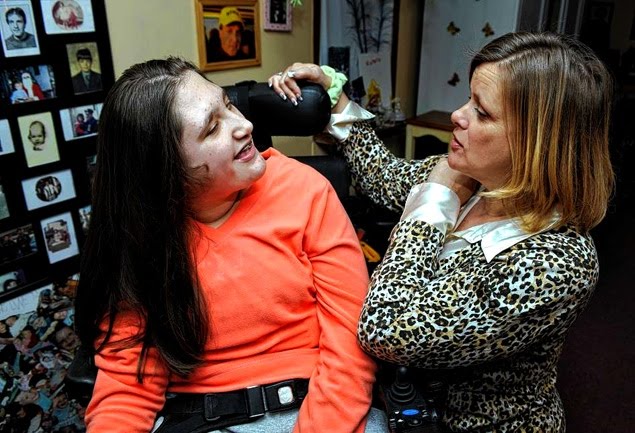
Marisa Murray helps her
mother, Nancy, prepare salad.
PITTSBURGH -- Those of us who have family members with developmental disabilities and the need for life-long support have a close relationship with Medicaid, perhaps more than many people realize.
From an early age, Medicaid is involved with our loved ones' health and well-being. During childhood years, Medicaid can pay for what private insurance does not cover for medical needs and therapies. When our children become adults, Medicaid can fund the services they need in their daily lives.
With one caveat: Medicaid provides this safety net only if it is adequately funded. At present, it is not. And with major changes proposed at the federal and state level this year, the safety net is expected to deteriorate further.

Friday, June 1, 2012

Elementary School Student Provides Inspiration

A colleague just shared this amazing video - definitely inspirational.


The young man who refuses to be beaten by his own limitations in the video above is Matt W. (last name unknown), who attends Worthington (Ohio) Colonial Hills Elementary School. Like most elementary schools in America, Colonial Hills has a once-a-year track and field day, and like most kids, Matt was clearly eager to take part.
However, unlike most of his peers, Matt suffers from spastic cerebral palsy, a debilitating condition that limits his ability to undergo rigorous physical exercise of any kind. Incredibly, despite knowing those limitations, Matt decided to run the 400-meter event (roughly quarter of a mile) on the school's 200-meter track.

Thursday, May 31, 2012

Relating to Children on the Spectrum

According to a study from the Centers for Disease Control and Prevention, one child in 88 has an autism spectrum disorder (ASD). That’s a 23-percent increase since the organization’s last report in 2009. That ratio is even higher in New Jersey, which reported one child in 49 diagnosed with an ASD.
While it may seem like an epidemic is underway, the CDC attributes a lot of this increase to improvements in identifying, diagnosing, and treating children with ASDs. It has absolutely nothing to do with vaccines, according to the Institute of Medicine, and the CDC agrees.
Some experts believe that New Jersey ranks so high simply because its medical and educational personnel are particularly adept at identification and diagnosis—and because parents in New Jersey are more aware of ASDs as well.

Monday, April 2, 2012

Should Some Services Be Carved Out of Managed Care?

From the New Hampshire Watchdog.org's Grant Bosse, Lead Investigator for the Josiah Bartlett Center for Public Policy, a free market think tank based in Concord, NH.
 
CONCORD, N.H. -- The New Hampshire Executive Council this week put off voting on a $2.2 billion contract to bring managed care to the state’s Medicaid program. Over the next month, they need to determine which Medicaid services would be cost-effective under managed care, and which should be left alone. There will be no easy answers, but perhaps the toughest question will be whether to include services for people with developmental disabilities.

Sunday, February 12, 2012

Young Adults Fear Medicaid Overaul

NEW YORK, N.Y. -- Thousands of young New Yorkers struggling with chronic illnesses are facing a new battle — they fear an overhaul of Medicaid will jeopardize their health care services when they turn 21.
These patients, some of whom were not expected to survive into adulthood, are living longer because of medical advancements.
But that means they will be affected by a new Medicaid cost-cutting plan to transfer physically impaired adults into managed long-term care programs.

Wednesday, April 6, 2011

Judge: Minnesota Autism Care 'Inconsistent'

ST. PAUL, Minn. -- A Ramsey County judge has ruled that Minnesota's Medicaid program has been "inconsistent" in paying for intensive autism treatment for some children while denying it to others.
But the ruling stops short of ordering the state to cover the treatment for a low-income child, identified as T.O., who is at the heart of the case.
The judge sent the issue back to an administrative law judge for further proceedings.
Amy Dawson, the lawyer representing T.O., had sued the state and HealthPartners for refusing to cover the child's bills for Applied Behavior Analysis (ABA) therapy. Dawson argued the state routinely paid those bills for more affluent families under a Medicaid program for disabled children, but refused it to low-income children like T.O., who was enrolled in a Medicaid managed-care program.